


If you are past your first trimester, you’ve likely heard the advice: “Don’t lie flat on your back for too long” and “Stop doing crunches.”
But does that mean you just stop training your core? Absolutely not.
In fact, maintaining core strength is critical for supporting your growing bump and preparing for labor. The secret weapon isn’t a plank—it’s that Birthing Ball (or exercise ball) gathering dust in the corner of your nursery.
According to board-certified Doctor of Physical Therapy (DPT) and Expect advisor Nicole Dugan, sitting on the ball helps engage your deep stabilizer muscles—specifically the pelvic floor and core—while providing comfortable support for your pelvis.
Here is a physical therapist-designed, urogynecologist-approved routine you can do right now.
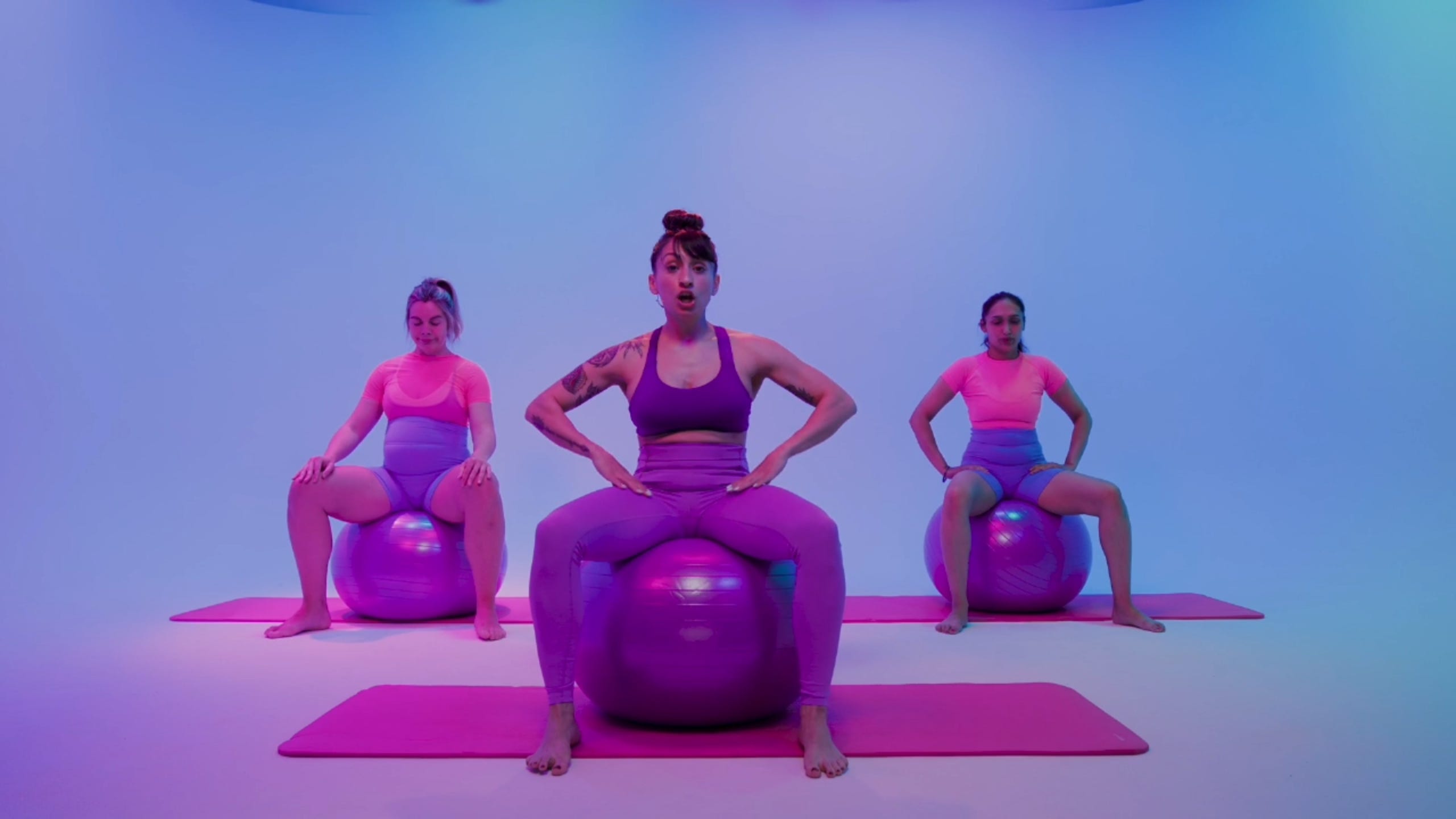
The Safety Protocol
Before you start, check your form. Expect clinicians emphasize three non-negotiables:
Posture: Sit with your knees in line with your hips. Keep your ears over your shoulders.
Breath: Never hold your breath. You should be able to talk while doing these moves.
Stability: If you feel wobbly, hold onto a stable surface or use a wall for support.
Move 1: The Rhythmic Bounce (The Warm-Up)
Why it works: This wakes up the pelvic floor and helps lymphatic flow without stress on the joints.
How to do it:
Sit tall on the center of the ball.
Bounce gently up and down in a rhythmic fashion.
The Count: Perform 2 slow sets (counting “1-Mississippi, 2-Mississippi”) to 10. Then, switch to 2 faster sets (counting to 20).
Pro Tip: This is also excellent for soothing lower back pain when the core muscles tire.
Move 2: Seated Marching (The Deep Core Stabilizer)
Why it works: This forces your deep core (the “corset” muscles) to fire, replacing the need for situps.
How to do it:
Start with feet flat on the floor, back tall.
Slowly lift one bent knee toward the ceiling, then return it to the floor.
Switch to the other leg.
The Challenge: Try to keep your hips perfectly still—don’t let them rock side-to-side.
Reps: Repeat 20 times per set. Do 2 sets.
Move 3: Opposite Arm & Leg Reach (The Balance Challenge)
Why it works: This connects your upper back posture with your lower body stability, crucial for carrying the extra weight of pregnancy.
How to do it:
Sit tall. Raise your Right Arm and Left Leg simultaneously. Since balance changes as you progress in pregnancy, keep a hand on a stable surface (like a wall or sturdy chair) for safety.
Hold for a split second, then lower.
Complete all reps on this side. Then, turn around (or move the chair) to switch sides and repeat with the opposite arm and leg.
Reps: 10 reps per side. Do 2 sets.
Move 4: The Pelvic Tilt (Mobility & Relief)
Why it works: This stretches the lower back and strengthens the low abs gently.
How to do it:
Initiate the movement from your hips, not your shoulders.
Tuck: Gently tuck your pelvis forward (think of flattening your low back).
Arch: Gently arch your pelvis backward.
Check: Ensure your shoulders stay level—only the pelvis moves!
Want the Full Follow-Along?
Reading about these moves is great, but following along with a real routine is more effective and fun.
In the Expect App, you can follow along with pregnant and postpartum moms in workouts designed by a board-certified PT and approved by a urogynecologist in our Physical Therapy Series to fully prep your body for delivery.
This is such a smart, reassuring reframe. Modify doesn’t mean stop. I love how this keeps core work functional, safe, and actually useful for pregnancy and labor. Also, the birthing ball as a core tool is wildly underrated.